

Transparency, Not Reach, Now Decides Where Mobile Budgets Go

Advertisers and agencies are shifting budgets to independent mobile advertising partners, and the driver is transparency.

A survey of 166 brand and agency leaders who buy programmatic mobile advertising, developed and fielded by EMARKETER in collaboration with Datum Intelligence. It maps where mobile money is moving, why proof of where an ad ran now decides partner selection, and how marketers reward channels that show their return.

A joint study by EMARKETER and Datum Intelligence

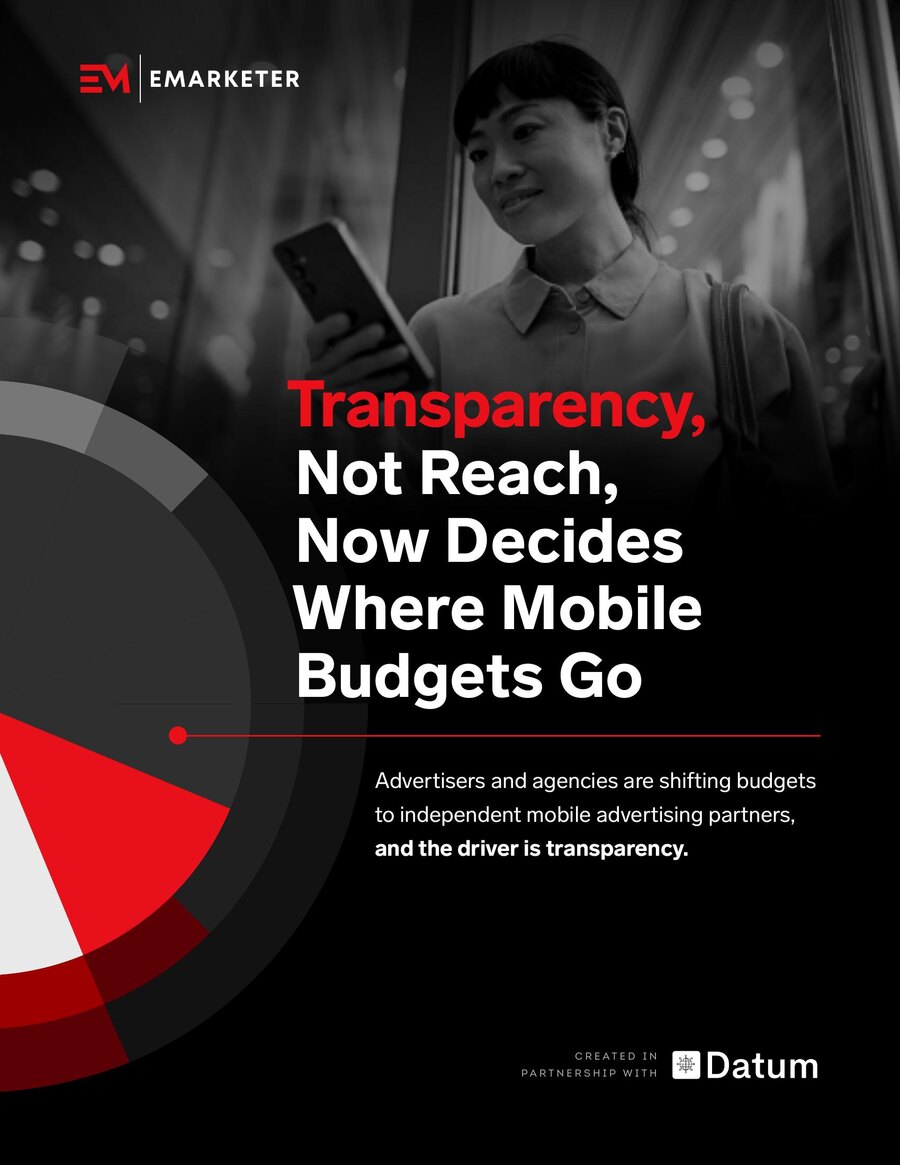
Cover of the EMARKETER and Datum Intelligence report, Transparency, Not Reach, Now Decides Where Mobile Budgets Go
63.9%
Moved mobile budget from walled gardens to independents in the past 12 months. Only 1.2% moved back.
90.4%
Call full supply-path transparency essential or very important when choosing a partner.
73.5%
Expect their allocation to independent channels to rise over the next three years.
42.2%
Fund an over-performing channel's raise with net-new incremental money, not reshuffled budget.

n=166. Source: EMARKETER and Datum Intelligence, “Independent Mobile Advertising Survey,” July 2026.

What the Report Covers

The Money Is Leaving the Walled Gardens

Advertisers and agencies are moving mobile budgets out of the walled gardens and into independent mobile advertising partners. The reason is plain. Marketers want to see exactly where their ads run, what they pay, and what they get back. Independent partners show them.

The shift is well underway. 63.9% of respondents moved mobile budget from walled gardens to independents in the past 12 months, and only 1.2% moved money the other way. Looking forward, 73.5% expect their allocation to independents to rise over the next three years, with 25.9% expecting a significant rise.

Large platforms still offer scale, but they keep their view of users and ad delivery paths behind the wall. Partners built directly into apps through their own technology can monitor the full delivery path of an ad and share it with the advertiser. Buyers now select for that proof, and the report shows how consistently they reward it.

Where the money is going

Expected change in allocation to independent channels, next three years

Rise significantly25.9%
Rise moderately47.6%
No rise expected26.5%
Already moved mobile budget out of the walled gardens in the past 12 months 63.9%

n=166. Source: EMARKETER and Datum Intelligence, “Independent Mobile Advertising Survey,” July 2026. Independent channels sit outside walled garden platforms such as Google, Meta, or TikTok.

The shift lands on a growing market

Independent partners are winning share of a pool that is itself expanding, so the gains compound.

12.0%
Forecast growth in US in-app mobile ad spend in 2026, per EMARKETER.
$235.10B
US in-app mobile ad spend next year, on EMARKETER's forecast.
49.4%
Expect to raise in-app mobile budgets by 5 to 10 percentage points in the next 12 months. Another 19.9% expect a rise of more than 10 points.

n=166. Source: EMARKETER and Datum Intelligence, “Independent Mobile Advertising Survey,” July 2026. Spend forecast: EMARKETER.

Key Findings

What the Study Found, in Plain Terms

Four findings run through the report, each backed by the survey numbers.

Budgets are moving to independent players and staying there

Marketers are voting with their dollars, in both current spend and future plans. Nearly two thirds, 63.9%, moved budget across in the past 12 months and only 1.2% moved it back. Looking ahead, 73.5% expect the independent share to keep rising over the next three years.

Transparency is the deciding factor

90.4% call full supply-path transparency, knowing exactly where an ad ran and what it cost, essential (41.0%) or very important (49.4%) when choosing a mobile partner. Pricing transparency ranks second among all selection criteria at 45.8%, ahead of brand reputation.

Marketers keep their own scorecard

They measure and reward ROI no matter how they pay, whether by CPM, cost per click, or cost per install. About 72% said accountability is the same or mostly the same regardless of payment model. Even on non-performance buys like CPM, 31.3% always measure channel-level ROI and 41.6% usually do. Only 5.4% never do.

Winning performance earns more money, often net-new money

67.5% increased spend with a CPM-paid partner because it delivered measurable ROI, and 28.3% of that group increased it significantly. When an over-performing channel gets a raise, 42.2% of marketers fund it with net-new incremental budget while 46.4% reallocate from other channels. Strong independent performance grows the overall pie rather than splitting it.

n=166. Source: EMARKETER and Datum Intelligence, “Independent Mobile Advertising Survey,” July 2026.

A lot of independent mobile channels give advertisers granular data on placements, audience, and bid prices. When combined with their own performance data, they can get fine-tuned ROI.
Yory Wurmser Principal Analyst, Advertising, Media & Technology EMARKETER

Partner Selection

What Decides the Buy

The criteria that most influence the choice of an independent mobile advertising partner. Respondents could select up to three. Two of the top four are transparency criteria, marked in red.

Top criteria for picking a partner

Share of respondents selecting each, up to three choices

Targeting & data53.0%
Pricing transparency45.8%
Brand reputation43.4%
Supply-path transparency29.5%
Quality / inventory verification28.9%
Independent measurement28.3%
Creative formats22.3%
First-party signals18.1%
All criteria Transparency criteria

n=166. Respondents could select up to three. Source: EMARKETER and Datum Intelligence, “Independent Mobile Advertising Survey,” July 2026.

90.4%

call full supply-path transparency essential or very important when choosing a mobile partner.

Essential, 41.0% Very important, 49.4% Somewhat, 6.0%

“Transparency is a big draw for marketers.”

Yory Wurmser, Principal Analyst, EMARKETER

n=166. Source: EMARKETER and Datum Intelligence, “Independent Mobile Advertising Survey,” July 2026.

Accountability

Marketers Keep Their Own Scorecard

Payment model does not change the standard. Whether a channel is bought on CPM, cost per click, or cost per install, marketers hold it to the same test: did it return the money. 33.7% apply the same accountability across all payment models and 38.6% mostly do, about 72% in total.

That scorecard covers buys with no built-in performance guarantee. On non-performance buys like CPM, 31.3% always measure channel-level ROI and 41.6% usually do. Only 5.4% never measure it.

Proof gets funded. 67.5% increased spend with a CPM-paid partner because it delivered measurable ROI, and 28.3% of that group increased it significantly.

33.7%
Same accountability across all payment models. A further 38.6% say mostly the same.
67.5%
Raised spend with a CPM-paid partner that proved measurable ROI. 28.3% of them raised it significantly.

ROI is measured even on CPM

How often marketers measure channel-level ROI on non-performance buys

Always31.3%
Usually41.6%
Never5.4%

n=166. Remaining responses fall between usually and never. Source: EMARKETER and Datum Intelligence, “Independent Mobile Advertising Survey,” July 2026.

Where the extra money comes from

Budget source when increasing spend on an over-performing channel

Net-new incremental, 42.2% Reallocated, 46.4% Not sure, 11.5%

n=166. Source: EMARKETER and Datum Intelligence, “Independent Mobile Advertising Survey,” July 2026.

Rewarding Performance

The Bigger the Beat, the Bigger the Raise

When a channel beats its performance target, marketers respond with budget. The further it beats the target, the larger the increase. At an 80% beat, 45.2% of marketers raise the channel's budget by more than 26%.

Budget response when a channel beats its performance target, by size of the beat. Darker cells mean a larger share of respondents.
Size of the beat No change Increase 1 to 10% Increase 15 to 25% Increase 26 to 50% Increase 50% or more
Beats target by +10%a solid quarter 22.9% 36.8% 12.1% 22.9% 5.4%
Beats target by +50%a strong quarter 11.5% 27.7% 30.1% 21.7% 9.0%
Beats target by +80%a breakout quarter 13.9% 20.5% 20.5% 28.9% 16.3%

n=166. Share of respondents choosing each budget response. Source: EMARKETER and Datum Intelligence, “Independent Mobile Advertising Survey,” July 2026.

The Advantage

Why Transparency Changes Who Wins

Transparency is not evenly distributed. Partners built directly into apps through their own technology, AppLovin, InMobi, and Liftoff among them, can monitor the full delivery path of an ad and share it with the buyer. Partners that resell inventory at a remove cannot show the same view.

That is why the established group holds 57.1% of future independent budgets, barely different from where the money sits today. Holding that share while the overall pie grows is the point. The advantage belongs to whoever can prove what happened.

57.1%
of future independent mobile budgets go to established partners such as AppLovin, InMobi, and Liftoff
40.7% goes to all other independents

n=166. Source: EMARKETER and Datum Intelligence, “Independent Mobile Advertising Survey,” July 2026.

From the Report

Planning a Mobile Campaign

The report closes with a practical checklist for marketers building their next mobile plan.

Identify independent measurement

Identify independent mobile measurement solutions before the campaign starts, not after.

Keep budgets flexible

Approve budgets that are flexible and don't hamper growth when a channel starts to win.

Demand transparency

Evaluate mobile partners that provide supply-path and price transparency.

Prove ROI independently

Ensure independent measurement to prove ROI so you can build on success.

Report Scope

What You'll Find Inside

01Exiting walled gardens
02The demand for transparency
03Rewarding ROI
04Reallocating budgets
05Checklist: planning a mobile advertising campaign
06About the survey and methodology
An 11-page PDF, published August 2026 Full charts, analyst commentary and the campaign planning checklist. Survey of 166 brand and agency leaders, fielded July 2026.

Get the Full Report

Tell us where to send research updates and the download starts right away.

Your Download Is Starting

Thanks. The PDF should begin downloading now. If it does not, use the direct link below.

Download the PDF directly

By downloading, you agree to receive occasional research updates from Datum Intelligence.

About EMARKETER

EMARKETER

EMARKETER is the leading research, data, and insights provider for marketing, advertising, and commerce professionals. Its data-centric forecasts and rigorous analysis support strategic decisions for revenue-driving teams, and its forecasts, reports, and benchmarks help companies anticipate market trends. EMARKETER is a division of Axel Springer S.E.

Method
Developed and fielded by EMARKETER in collaboration with Datum IntelligenceOnline survey, July 2026
Respondents
166 brand and agency leadersDirect involvement in programmatic mobile advertising
Author
Chris WoodAnalyst, Media, EMARKETER
Contributor
Yory WurmserPrincipal Analyst, Advertising, Media & Technology, EMARKETER